
The Universe in Your Hands: Why Binoculars May Be the Best Telescope You'll Ever Own
There is a particular moment familiar to anyone who has spent time under a dark sky. Your eyes adapt. The horizon fades. The stars stop looking like points and begin looking like geography. Constellations become terrain. The Milky Way ceases to resemble a pale cloud and resolves into a fractured river of light.
Then you lift a pair of binoculars.
Suddenly the sky explodes.
Clusters emerge from apparent emptiness. Nebulae become textured. Star fields multiply beyond intuition. You are no longer looking at stars; you are navigating structure in the galaxy itself.
Modern astronomy culture often treats binoculars as a stepping stone toward “real” instruments—an apprentice tool to be discarded once a large Dobsonian telescope enters the garage. This is a mistake. In many circumstances, binoculars are not merely convenient. They are optimal. For large swaths of the night sky, especially for beginners and for observers under imperfect conditions, binoculars deliver one of the richest and most human experiences astronomy can offer.
The irony is profound: the best instrument for exploring the cosmos may be the one least associated with serious astronomy.
One of the great things about astronomy is that you can financially participate on any level. You need very little or no money to enjoy astronomy or you can take a second mortgage on your house! Today we are going to talk about less expensive journeys in astronomy.
To help you get started, there are many free resources on the internet that you can use to learn what is going on in your backyard!
First the easiest object in the sky- The Moon.
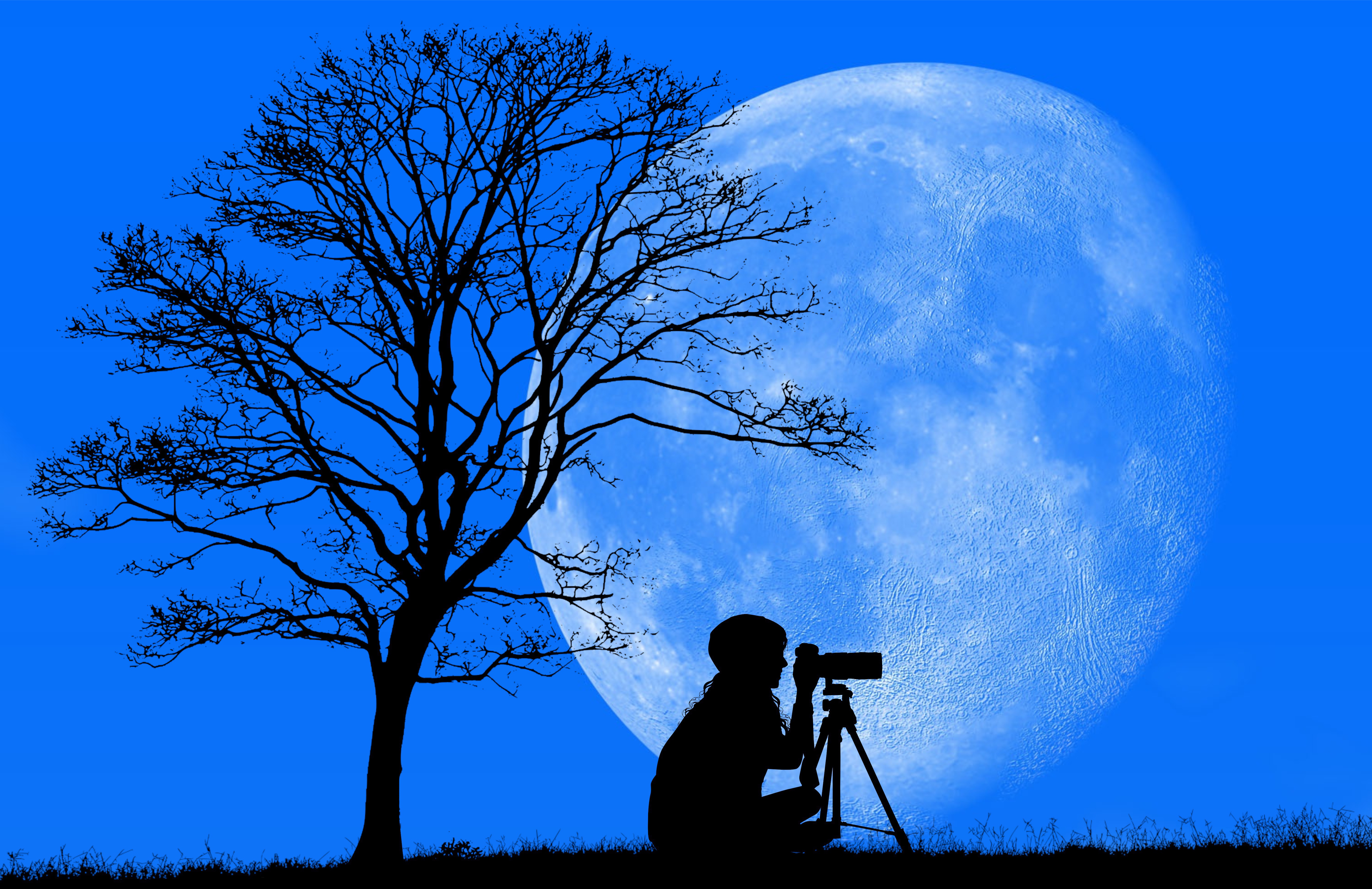
Learn the phases and watch the moon over time. More things are going on with the moon than you know. The Moon through binoculars is almost unfairly beautiful.
The terminator—the line dividing lunar night from lunar day—reveals crater shadows with extraordinary relief. Even modest binoculars show maria, major craters, and rugged mountain chains.
Counterintuitively, the full Moon is often less interesting than crescent or quarter phases because direct overhead sunlight removes shadows and flattens topography.
Some resources to help you with your lunar knowledge are below:
Second, you need to get familiar with the common constellations and the major stars. If you want to dive deeper, each constellation has fascinating stories about them. Some good resources are listed below:
Next, step outside after the sun goes down and try to find some of these constellations. A technique called "star hopping" relies on knowing the order of the major constellations. You start with one you know (like Orion) and look to the left or right and find the next constellation and so on until you reach your destination. In this way, you can "navigate" the biggest portion of the sky!
You can also use an app to find the objects in the sky. Some of the more popular ones are:
Stellarium
Starwalk
Sky Portal
Sky Safari
These apps utilize Augmented Reality (AR) to help you find objects.
Once you are getting familiar with locations in the night sky, use binoculars to enhance your vision. Some tips on how to use and buy binoculars along with other resources are below.
Other popular objects include:
Jupiter

With steady hands or a mount, Jupiter resolves into a bright disk accompanied by tiny points of light: the Galilean moons discovered by Galileo Galilei in 1610.
Watching those moons shift position night after night produces a strange cognitive effect. You are witnessing orbital mechanics directly. No simulation. No interpretation. The Solar System visibly moves.
The Pleiades
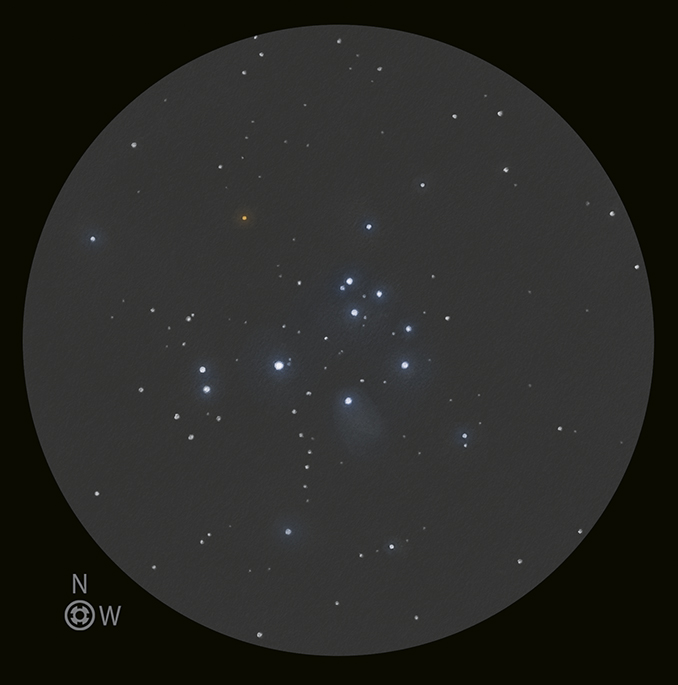
The Pleiades are perhaps the perfect binocular object.
To the naked eye they resemble a small knot of stars. Through binoculars they bloom into dozens of blue-white suns suspended in blackness. The cluster spans too much sky for many telescopes to frame comfortably, but binoculars capture it naturally.
This is an open cluster roughly 440 light-years away: young, hot stars born from the same molecular cloud.
You are seeing stellar siblings.
The Andromeda Galaxy (M31)
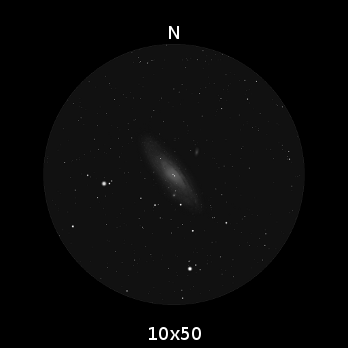
Andromeda is the most distant object visible to the unaided eye under good conditions. At 2.5 million light years away, it is a testament to its brightness and size that we can see it at all!
Binoculars reveal its elongated core and hints of its vast galactic structure. The experience is existentially destabilizing in the best way possible.
Every photon entering your retina originated from a trillion-star galaxy outside the Milky Way.
The Orion Nebula
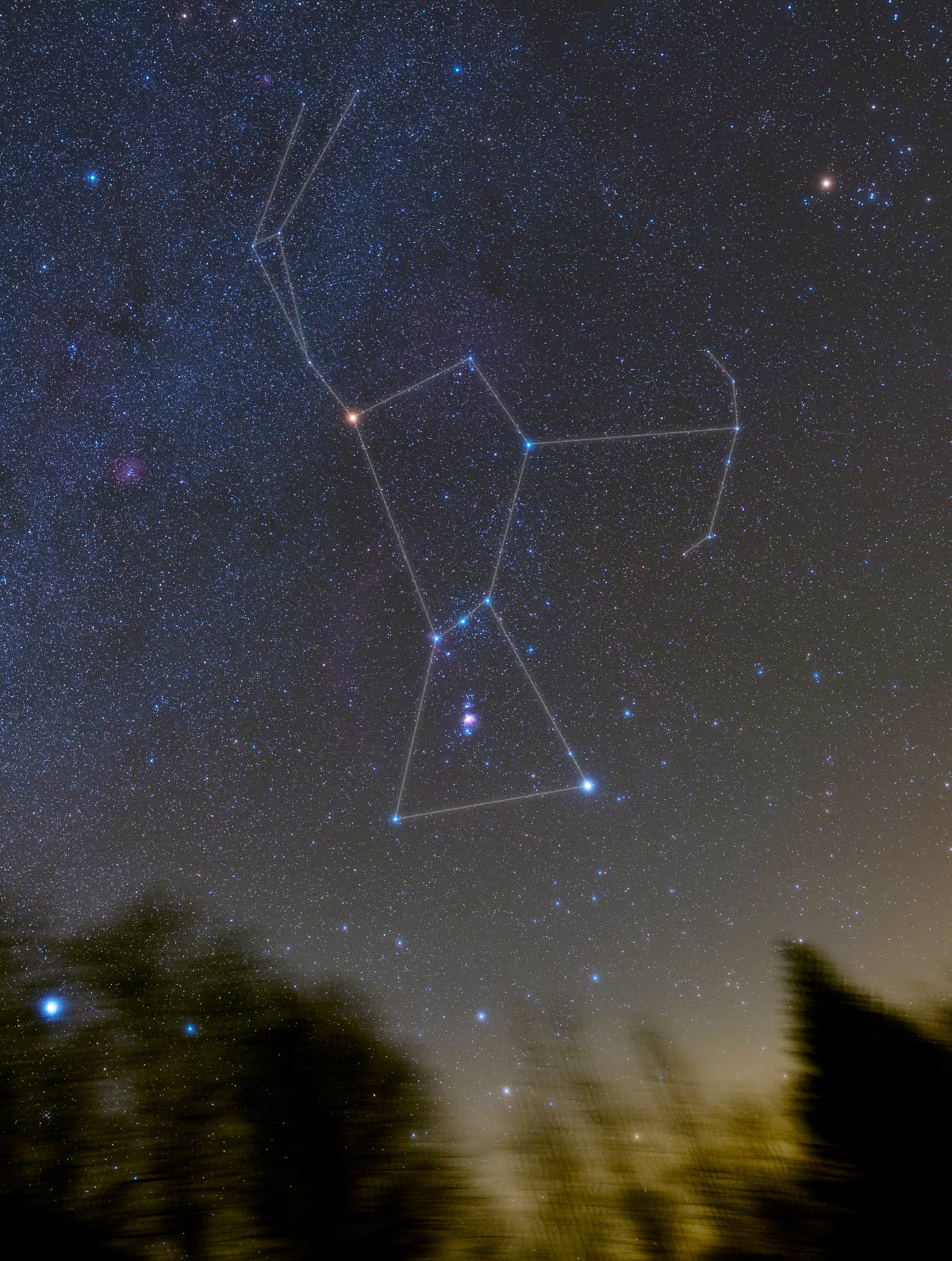
The constellation Orion is a favorite of astronomers. The four stars that make up the frame of Orion are Betelgeuse and Bellatrix that make up the shoulders and Rigel and Siaph are the two legs of Orion. The three bright stars in the middle is called Orion's Belt. Just below the belt is what looks like a fuzzy star. Looking through binoculars reveals the gem of the Orion nebula. It is wonderful and easy to spot for half of the year.
Where to Go From Here
There are endless things to do! Start a list of all the objects you've identified and keep track of them in a journal or map. The internet has limitless information suited for binocular viewing. Make a game out of it with friends. Start a club. For myself, I would just lay flat on a lawn chair and look up for hours. I understand a trampoline works pretty good for groups. You can take that lawn chair anywhere and plop it down under a nice dark sky. Going to the country? Don't forget your lawn chair and binoculars!
For years of fun with binoculars, I give you this primer. A very good catalog of binocular objects compiled from the Sky & Telescope folks.
There is also something philosophically important about binocular astronomy.
The barrier to entry is low.
You do not need an observatory. You do not need computerized tracking. You do not need astrophotography rigs, cooled CMOS sensors, calibration frames, or machine-learning denoising pipelines.
You need darkness, patience, and curiosity.
A pair of binoculars transforms the entire sky into accessible territory.
In an era increasingly defined by abstraction—where scientific understanding arrives filtered through simulations, renderings, and data visualizations—direct observation carries unusual psychological force. You are not consuming an image produced by someone else’s instrument. You are gathering photons yourself.
That matters.
The experience reconnects astronomy with its oldest roots: humans standing beneath the night sky trying to understand where they are.


