
Filling a 65-mile long ship with air?
How Do You Fill a 65-Mile-Long Spaceship With Air?
Imagine building a spaceship 65 miles long.
Not a rocket with a few astronauts packed into a cabin. Imagine a moving world carrying more than a million people, complete with apartments, farms, factories, hospitals, parks, transportation systems, and everything else necessary for a civilization traveling between the stars. Eventually somebody has to ask a deceptively simple question:
How do you fill the thing with air?
For a spacecraft the size of Atlantis in The Journey of Atlantis, that question becomes an enormous engineering problem. The surprising answer is that we probably wouldn't manufacture all the "air" in the way you might expect. And oxygen isn't necessarily the hardest part.
First, How Much Air Are We Talking About?
Let's do a rough calculation.
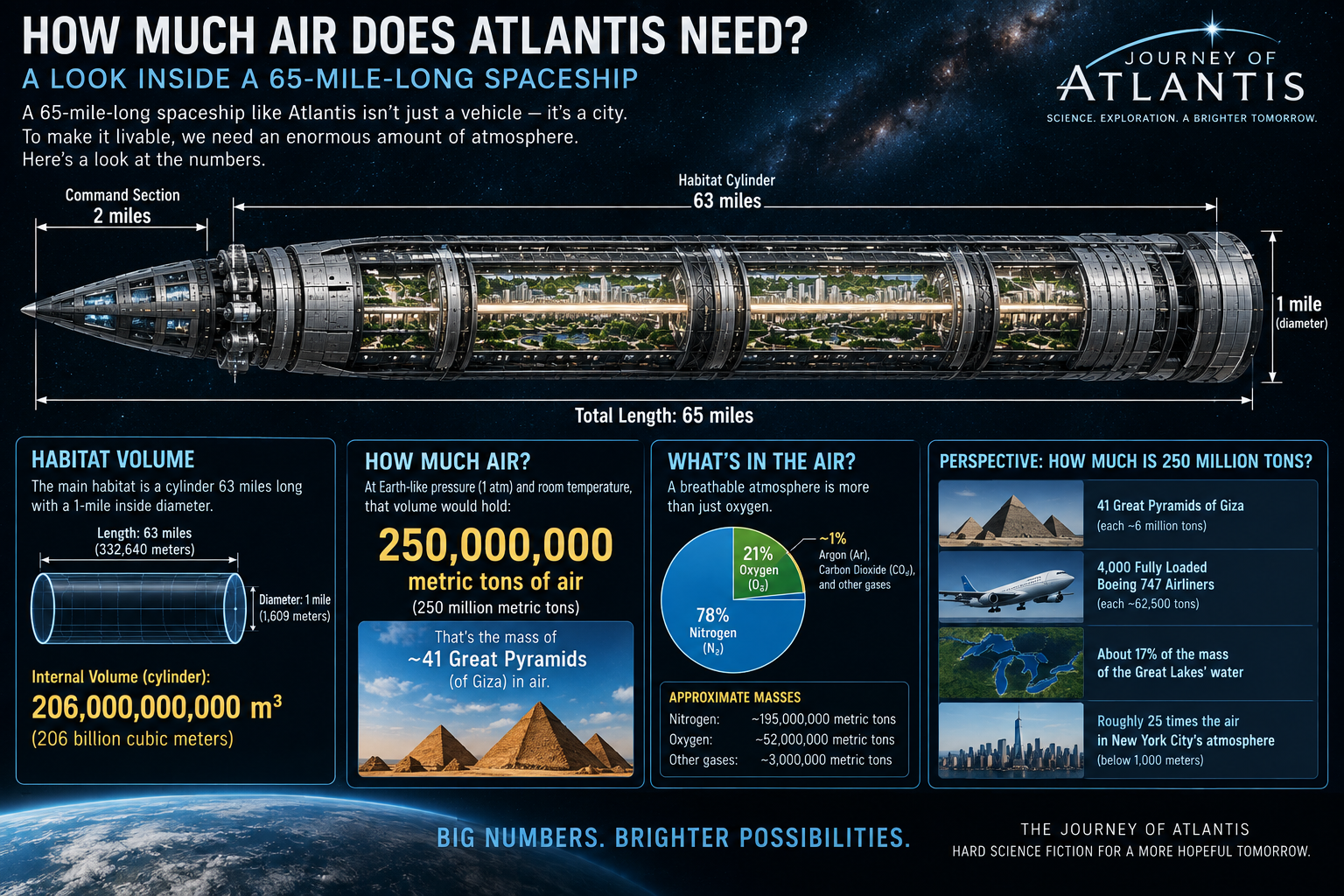
Atlantis's main habitat is a cylinder approximately:
63 miles long
1 mile in internal diameter
Treating the habitat as one enormous cylinder gives an internal volume of approximately:
206 billion cubic meters.
At roughly Earth sea-level pressure and room temperature, that volume could contain on the order of:
250 billion kilograms of air.
That's approximately:
250 million metric tons.
And that's before considering the ship's command section.
Of course, the real ship wouldn't be an empty tube. Buildings, decks, machinery, water reservoirs, farms, structural members, storage areas, factories and other equipment would occupy a significant portion of the volume. But even if those structures displaced half of the available atmospheric volume, we would still be talking about well over 100 million tons of atmosphere. Suddenly "put some oxygen tanks aboard" doesn't sound like much of a solution.
Air Isn't Just Oxygen
Here's the first misconception. Earth's atmosphere is only about 21% oxygen by volume. Most of what you're breathing right now is nitrogen.
Earth's dry atmosphere is approximately:
78% nitrogen
21% oxygen
~1% argon and other gases
~0.04% carbon dioxide
So if we're trying to recreate something close to an Earth-normal atmosphere, we don't merely need oxygen. We need an enormous quantity of buffer gas. Nitrogen is especially useful because breathing pure oxygen creates serious physiological and fire-safety problems. The atmosphere therefore needs enough oxygen to support respiration while maintaining an appropriate total pressure and oxygen partial pressure.
NASA spacecraft already have to control exactly these kinds of variables. Environmental control systems regulate atmospheric pressure, oxygen concentration, carbon dioxide, humidity, contaminants and ventilation. Scaling that from a spacecraft cabin to an artificial world is the challenge.
Where Would the Oxygen Come From?
This part is actually relatively straightforward chemically.
Water.
The chemical formula tells the story:
H₂O.
Every water molecule contains oxygen.
Using electricity, water can be split through electrolysis into hydrogen and oxygen. NASA already does this aboard the International Space Station. Water enters the Oxygen Generation System, where electrolysis separates it into oxygen and hydrogen. The oxygen enters the cabin atmosphere. A generation ship could use the same basic principle on a vastly larger scale.
And Atlantis already needs tremendous quantities of water.
Water is needed for:
Drinking
Agriculture
Hygiene
Industrial processes
Food production
Cooling
Radiation shielding
That last use is especially important.
A huge reservoir of water surrounding the inhabited areas could serve two purposes simultaneously: radiation shielding and oxygen reserve. Instead of carrying a separate oxygen supply and a separate radiation shield, some of the same mass could contribute to both systems.
But There's a Catch
If we split water to obtain oxygen, we haven't created matter. We've rearranged it. Remove enough oxygen from the ship's water supply and eventually we have less water. That's why a starship cannot simply keep electrolyzing its water forever.
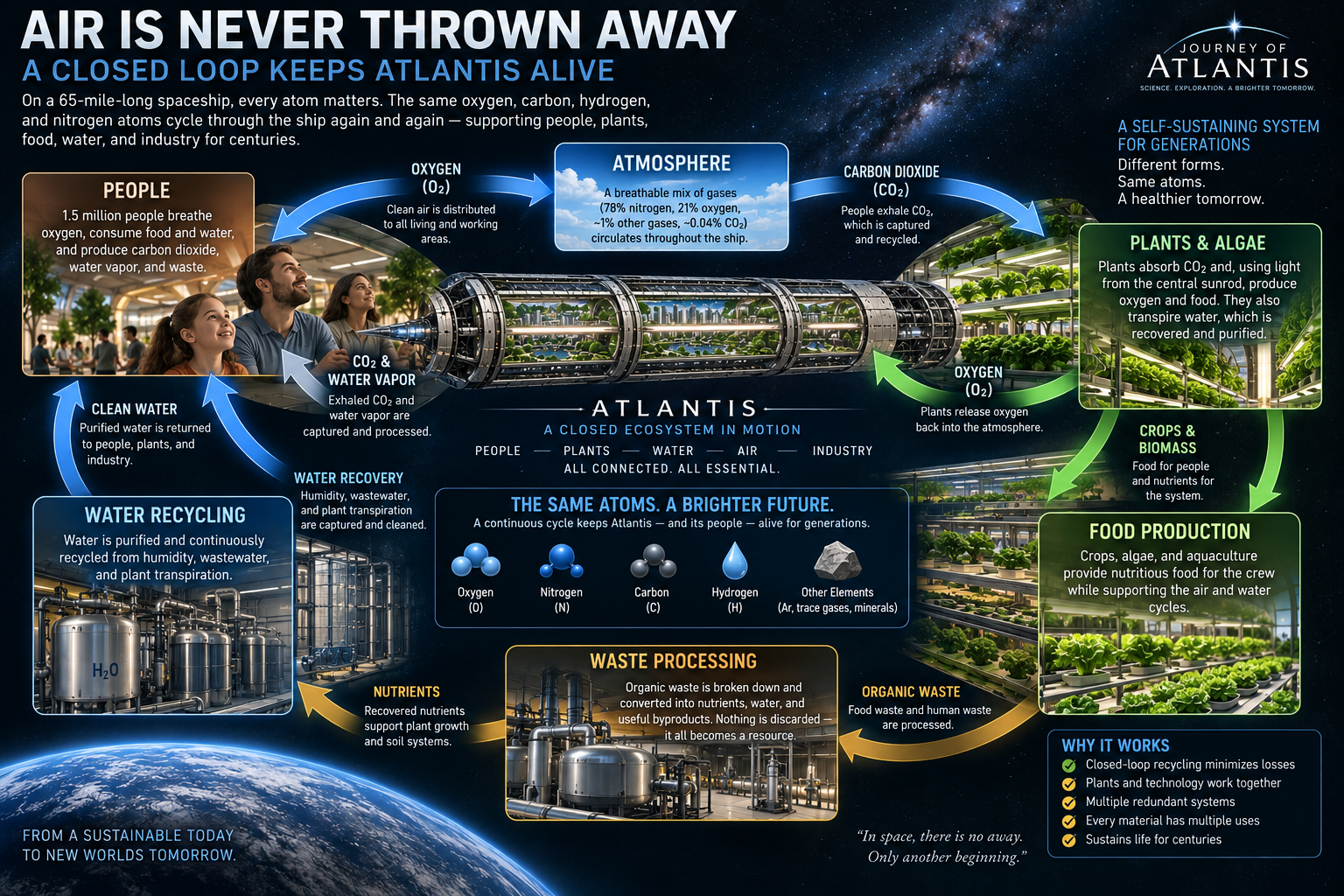
The atmosphere must become part of a closed chemical cycle. Humans breathe oxygen and produce carbon dioxide. Plants consume carbon dioxide and, with light, release oxygen. Water is consumed and produced throughout biological and industrial processes. Carbon moves through food, people, plants and waste. The goal isn't continually making new air. The goal is never losing the atoms you already have.
The Ship Becomes a Giant Recycling Machine
This is the real secret to filling a generation ship with air. You fill it once. Then you keep that atmosphere circulating for centuries.
NASA is already developing regenerative life-support systems for precisely this reason. The International Space Station recycles water, removes carbon dioxide and generates oxygen, although current systems are not completely closed and still require resupply. NASA's longer-term work aims at much higher oxygen recovery because resupply becomes increasingly impractical on deep-space missions.
A generation ship would have to take that concept much further. Imagine the atmospheric loop:
People → CO₂ → processing/plants → O₂ → people
At the same time:
Waste → nutrients → crops → food → people → waste
And:
Wastewater → purification → clean water → people/agriculture → wastewater
Nothing is really thrown away. There is nowhere to throw it.
Plants Would Become Part of the Machinery
Aboard a ship like Atlantis, farms aren't merely places where food grows. They are components of the life-support system. Plants absorb carbon dioxide. Through photosynthesis they release oxygen. They also transpire water vapor, which can be captured, condensed, purified and returned to the water system.
NASA has investigated bioregenerative closed-loop systems because plants potentially contribute simultaneously to food production, atmospheric revitalization and water recycling. A large generation ship could therefore combine mechanical and biological systems. Mechanical systems provide precision and reliability. Biological systems provide food while helping cycle carbon, oxygen and water. Neither system should be trusted alone. Redundancy would be essential.
The Harder Question: Where Does the Nitrogen Come From?
This is where things get interesting. Oxygen can be extracted from water. Nitrogen can't. The ship must obtain its nitrogen inventory somewhere. Earth's atmosphere contains an enormous amount of nitrogen, but collecting millions of tons of atmospheric nitrogen and launching it from Earth's surface would be extraordinarily expensive.
So a civilization capable of constructing Atlantis would probably avoid lifting all that mass from Earth's surface. Instead, much of the ship's raw material could come from space-based resources.
Certain asteroids and other Solar System bodies contain nitrogen-bearing compounds. Ammonia is particularly useful because it contains nitrogen and hydrogen:
NH₃.
With sufficient energy and chemical processing, nitrogen-containing compounds could provide nitrogen for the ship's atmosphere. This changes how we should imagine building an interstellar spacecraft. You wouldn't construct the entire thing on Earth and launch it. You would build much of it in space.
The Solar System Becomes the Shipyard
A civilization building a 65-mile spacecraft would probably operate an enormous space-based industrial infrastructure first.
Asteroids could supply:
Iron
Nickel
Carbon
Silicates
Water
Nitrogen-bearing compounds
Other useful elements
Comets and icy bodies could supply additional volatile materials. Mining vehicles would gather them and processing facilities would separate them. Orbital factories would manufacture structural components. Obtaining these Solar system bodies for processing would take a huge amount of time given the current propulsion limitations. Compressing and liquifying Earth atmosphere would be expensive from an energy prospective, but would save enormous amounts of time.
The atmosphere itself could become one more construction material. Instead of asking:
"How do we launch 200 million tons of air?"
the engineers would ask:
"Where do we acquire the atoms needed to manufacture our atmosphere?"
That's a very different problem.
Don't Pressurize the Entire Ship at Once
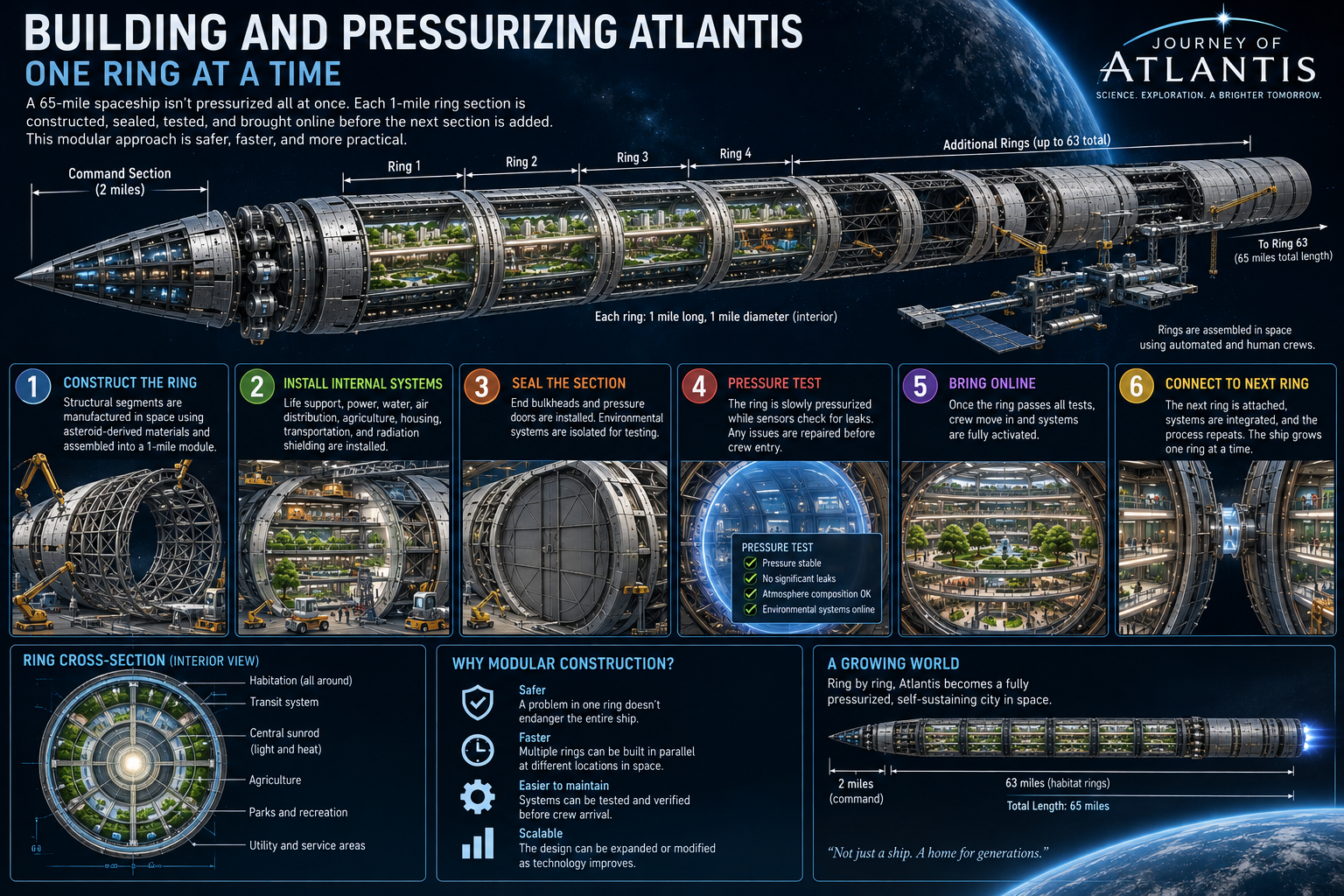
There is another important engineering trick. Atlantis wouldn't necessarily be filled with air like someone inflating an enormous balloon. Its 63-mile habitat is constructed from repeated one-mile ring sections. That modular architecture provides an enormous advantage. Each section could be pressure-tested and commissioned independently.
Imagine construction progressing down the ship:
Ring 1 — sealed and pressurized
Ring 2 — sealed and pressurized
Ring 3 — sealed and pressurized
Ring 4 — sealed and pressurized
Eventually the individual environments connect. This is much safer than attempting to pressurize an entire 63-mile structure simultaneously. It also provides compartmentalization.
Compartmentalization Could Save the Ship
One giant atmosphere would be dangerous. Suppose a meteor punctured the hull. If the entire 63-mile habitat were one continuous pressure vessel, an enormous amount of atmosphere could potentially escape. Instead, the ship could be divided into hundreds or thousands of pressure zones.
Normally, doors and passageways remain open. During an emergency, massive pressure doors automatically close. A damaged section is isolated. The rest of the ship survives. Ships already use watertight compartments. A starship would use airtight compartments. Pressure sensors distributed throughout Atlantis could identify even tiny leaks long before they became catastrophic.
You Would Also Need an Atmospheric Reserve
Even a nearly perfect recycling system won't be perfect. Some gases will inevitably be lost through:
Airlocks
Docking operations
Maintenance
Micrometeoroid damage
Equipment failures
Manufacturing processes
Leakage
Over a journey lasting centuries, tiny losses accumulate. Atlantis therefore needs strategic reserves. Nitrogen and oxygen could be stored as compressed gases, cryogenic liquids, water, or chemically bound compounds. The enormous saltwater radiation shielding surrounding the habitat would also represent a tremendous reservoir of oxygen atoms. The ship wouldn't simply carry air. It would carry the ingredients for air.
What About 1.5 Million People?
Now the atmosphere becomes even more interesting. A population of approximately 1.5 million people would consume a tremendous amount of oxygen every day. But again, oxygen consumption doesn't mean those oxygen atoms disappear. They change chemical form. A person inhales oxygen. Metabolism uses it. The person eventually exhales much of that oxygen incorporated into carbon dioxide and water. Life-support systems capture those compounds. Plants and machinery recover the oxygen.
NASA's current spacecraft systems already perform portions of this cycle. For long-duration missions, NASA specifically identifies highly efficient recovery of water and oxygen as essential because an open-loop approach creates enormous resupply requirements. Atlantis simply takes the idea to its logical extreme.
Air Becomes Infrastructure
On Earth, we rarely think of air as infrastructure. It's just there. On Atlantis, every molecule matters.
The atmosphere would have its own:
Pumps
Ducts
Sensors
Purifiers
Compressors
Storage tanks
Emergency reserves
Chemical processors
Biological processors
Pressure-control systems
Atmospheric management would be as fundamental to the ship as electrical power. Probably more so. Lose electricity temporarily and civilization has an emergency. Lose atmospheric pressure and people have minutes.
So Could We Actually Do It?
With today's technology? Not at this scale. But there's nothing obviously impossible about it.
We already know how to:
Separate gases
Liquefy gases
Store gases
Produce oxygen from water
Remove carbon dioxide
Purify contaminated air
Recycle wastewater
Grow plants hydroponically
Monitor atmospheric composition automatically
NASA's existing life-support systems already combine several of these functions aboard spacecraft. The challenge is scale, reliability and longevity.
A system operating for six months is one problem. A system supporting more than a million people for centuries is something entirely different.
The Biggest Lesson
Perhaps the strangest thing about filling a 65-mile-long spaceship with air is that you don't really fill it with "air." You fill it with matter.
Water.
Nitrogen compounds.
Carbon.
Hydrogen.
Oxygen.
Plants.
People.
Then you build an ecosystem capable of continuously rearranging those atoms into whatever forms civilization needs. Water becomes oxygen. Oxygen becomes carbon dioxide. Carbon dioxide becomes plant tissue. Plants become food. Food becomes people. Waste becomes nutrients.
And the cycle begins again.
A generation ship isn't merely a machine traveling through space. It is a carefully balanced artificial biosphere. Earth already does exactly that on an unimaginable scale. The real challenge of building Atlantis isn't figuring out how to carry enough air. It's figuring out how to build a tiny Earth—and make sure it never stops working.


