
Rogue Neutron Stars
Rogue Neutron Stars: The Invisible Wanderers That Could Threaten Entire Solar Systems
Imagine an object with more mass than our Sun compressed into a sphere only about 12 miles across.Now imagine that object moving silently through interstellar space.
No bright glow.
No blazing tail.
No warning.
Just gravity.
That object could be a rogue neutron star—one of the most extreme and dangerous wanderers in the galaxy. Unlike the stars we see shining in the night sky, rogue neutron stars can be nearly invisible. Yet despite their small size, their gravitational influence can reshape planetary systems, disrupt comet clouds, and in the worst cases, threaten the long-term survival of life on entire worlds.It sounds like science fiction.But the science behind rogue neutron stars is very real.
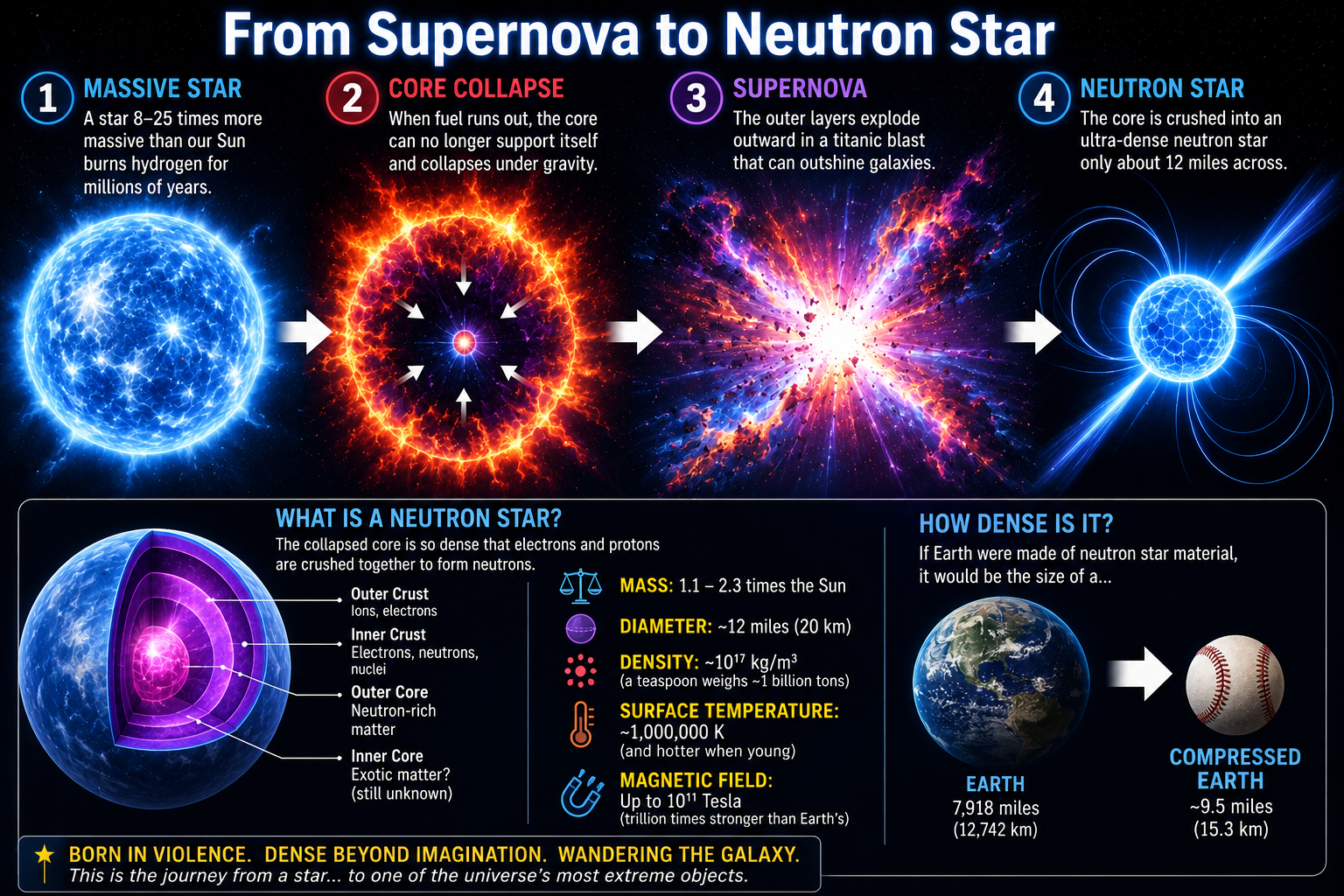
What Is a Neutron Star?
A neutron star is the collapsed core of a massive star that exploded in a supernova.
Stars roughly 8–25 times the mass of the Sun spend millions of years fusing heavier and heavier elements in their cores. Eventually, fusion stops producing enough outward pressure.
Gravity wins. The core collapses catastrophically. Electrons and protons are crushed together to form neutrons.
The result? A neutron star.
These objects typically contain:
Mass: ~1.1–2.3 solar masses
Diameter: ~12–15 miles (20–25 km)
Density: unimaginably high
A teaspoon of neutron star material would weigh roughly a billion tons on Earth.
That number is so absurd it barely feels real. Yet it’s accurate.
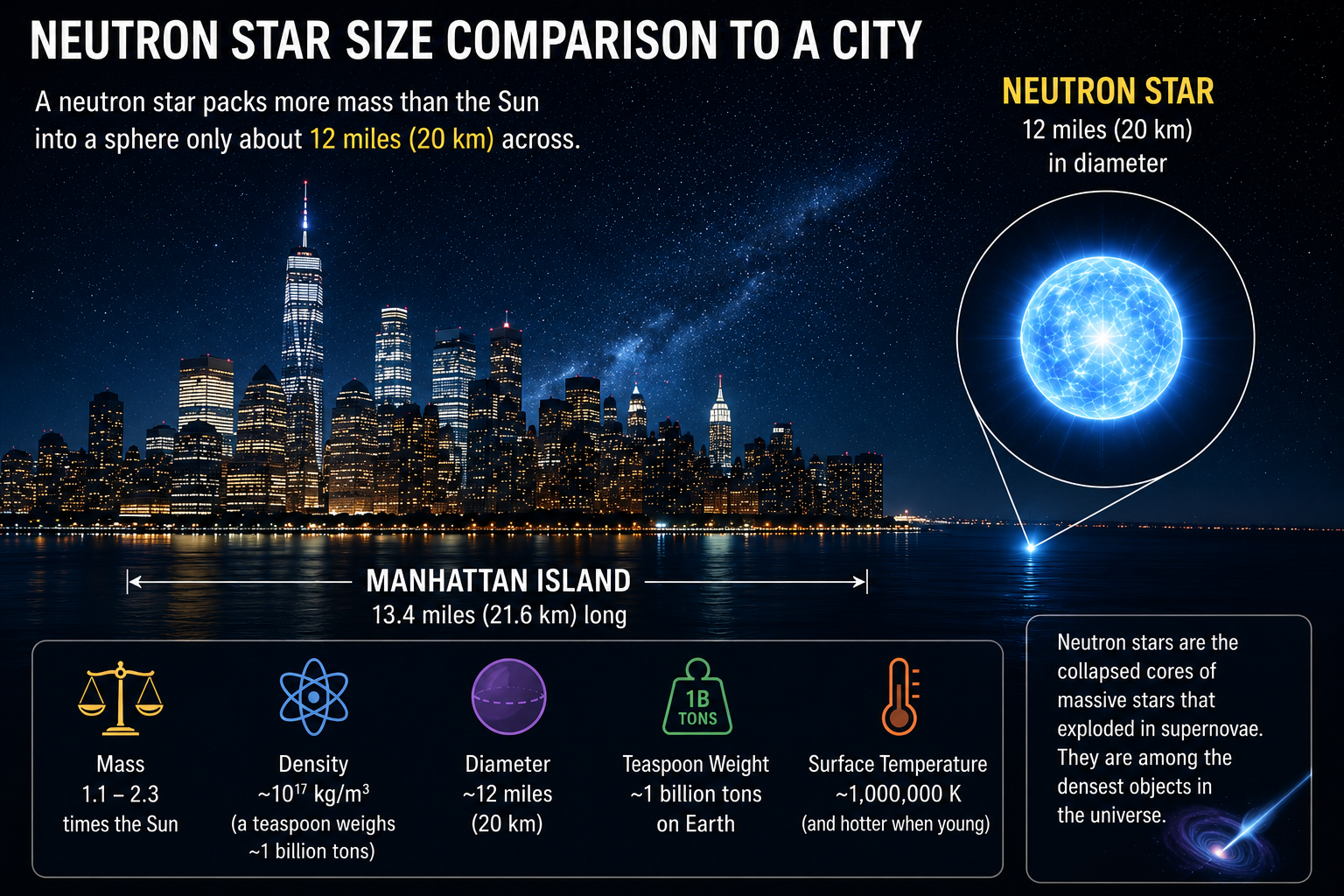
Just How Dense Is a Neutron Star?
To appreciate neutron star density, consider this:
If Earth were compressed to neutron-star density, our entire planet would fit into a sphere only a few hundred feet across. That’s the power of gravity when matter collapses beyond ordinary atomic structure.
Most empty space inside atoms disappears. Matter becomes nuclear matter. At this point, physics enters territory we still don’t fully understand.
Deep inside neutron stars may exist:
Superfluids
Exotic quark matter
Hyperons
Other states of ultra-dense matter
This makes neutron stars natural laboratories for extreme physics.
How Do Neutron Stars Become Rogue?
Not all neutron stars remain anchored to their birthplace. Many are violently kicked into space during supernova explosions. These kicks happen because supernova explosions are rarely perfectly symmetrical. Even a small imbalance can launch the collapsed remnant at enormous speeds.
Typical neutron star velocities:
200 mph? Not even close
2,000 mph? Still too small
200,000–1,000,000+ mph? Much closer
Some travel over 1,000 kilometers per second. That’s fast enough to escape their stellar neighborhoods entirely. These become rogue neutron stars. They wander the Milky Way alone.
No companion star.
No solar system.
Just motion through darkness.
Why Are Rogue Neutron Stars Hard to Detect?
This is what makes them so unsettling.
They’re small.
They’re dark.
They emit little visible light.
Some neutron stars are easy to detect because they are:
Pulsars
X-ray emitters
Magnetars
These emit powerful radiation. But older rogue neutron stars cool over time. Eventually they may emit very little. That means they become incredibly difficult to find unless:
They pass in front of a star and cause gravitational lensing
They interact with gas clouds
They emit detectable radio or X-ray signatures
In many cases, we might not notice one until it gets relatively close by astronomical standards.
That’s a sobering thought.
Could One Enter Our Solar System?
This is the question people really want answered.
The short version:
Yes—but it’s extraordinarily unlikely.
Space is vast. The average distance between stars in our neighborhood is about 4–5 light-years.
Even though the Milky Way may contain hundreds of millions of neutron stars, the odds of one passing dangerously close anytime soon are extremely low. But “unlikely” does not mean impossible.
And if one did approach…
Things could get ugly.
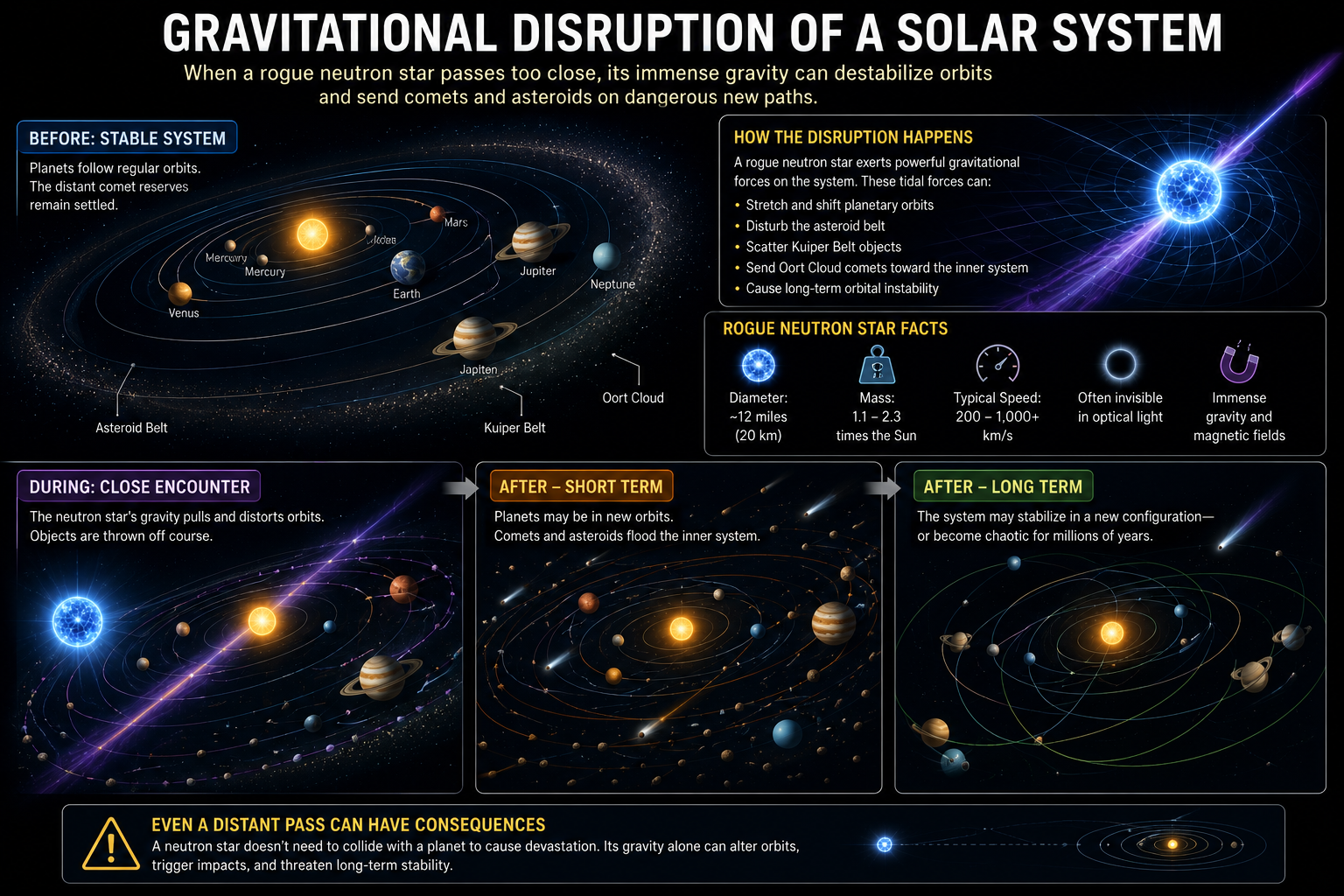
The First Warning: Orbital Disturbances
A rogue neutron star wouldn’t need to collide with Earth to cause disaster. Its gravity alone could cause enormous problems.
Possible early effects:
Disturbed comet orbits
Kuiper Belt disruption
Oort Cloud perturbation
Increased inward-falling comets
The Oort Cloud is thought to contain trillions of icy bodies far beyond Pluto. A close gravitational encounter could send many of these objects inward. That means higher chances of impacts over long timescales.
What If It Passed Near Pluto?
Even at extreme distances, a neutron star’s gravity matters. Suppose a rogue neutron star passed near the outer solar system.
Potential effects:
Altered planetary orbits
Eccentric orbital shifts
Increased collision risks
Long-term climate instability
Even small orbital changes matter. Earth’s climate depends heavily on orbital stability. Tiny gravitational changes over time can have major consequences.
What If It Passed Close to Earth?
This is where things become catastrophic. Neutron stars have immense gravity. Near enough, tidal forces become devastating.
Potential consequences:
Massive earthquakes
Extreme tidal disturbances
Crustal stress
Orbital destabilization
Atmospheric disruption
And that’s before radiation enters the picture.
If the neutron star were active—a pulsar or magnetar—the radiation hazard becomes even worse.
Possible exposure includes:
X-rays
Gamma rays
Charged particle storms
These could damage:
Electronics
Satellites
Power grids
Atmosphere
DNA
That combination could threaten civilization itself.
Could We Detect One Early?
Probably.
But how early depends on the object. Detection methods include:
Gravitational Microlensing
Its gravity bends background starlight. This can reveal otherwise invisible objects.
Infrared Surveys
Warm remnants may emit faint heat.
X-ray and Radio Detection
Active neutron stars remain detectable. Large observatories help here, including facilities like the National Radio Astronomy Observatory.
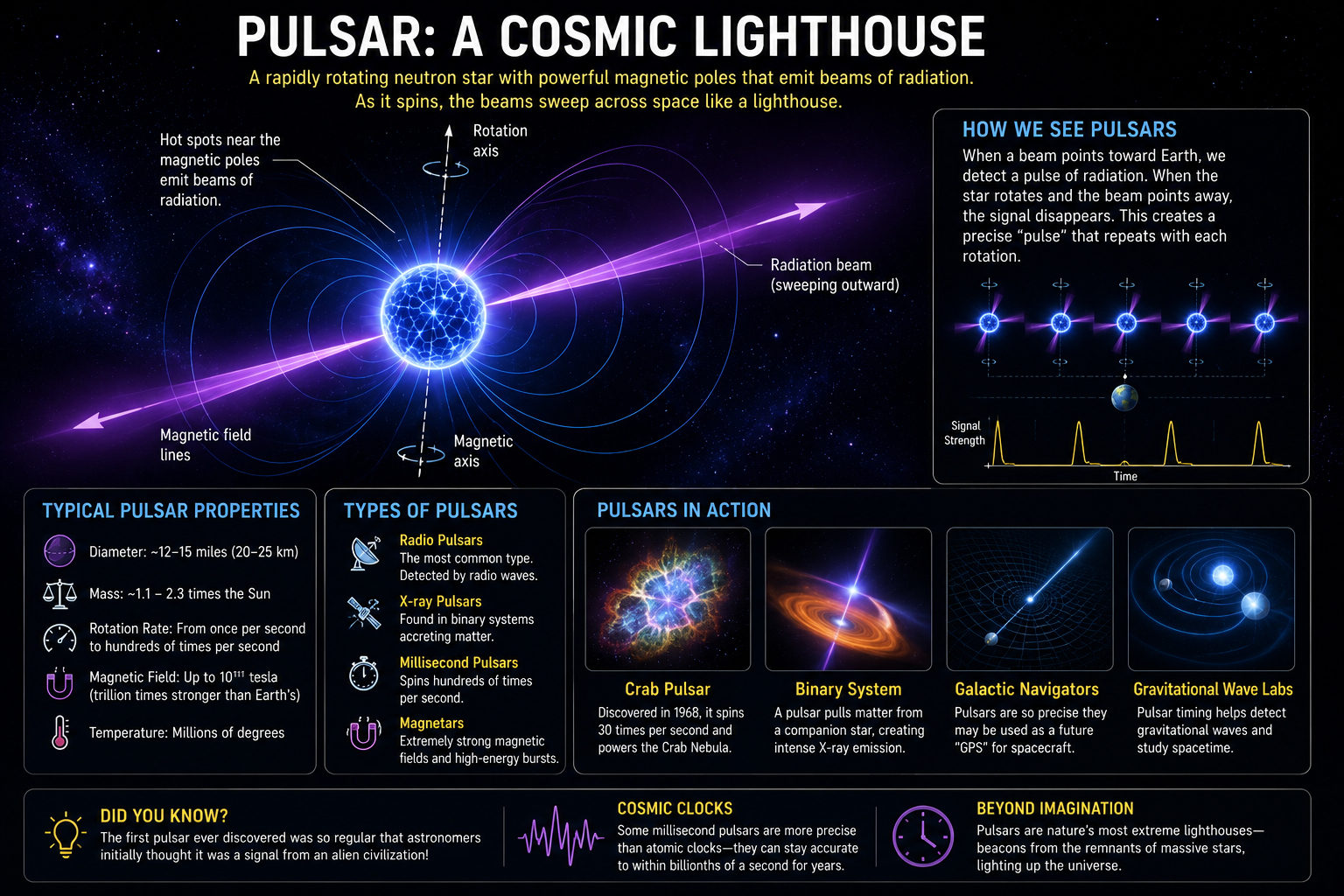
The Strange Case of Pulsars
Some neutron stars rotate incredibly fast. These are called pulsars. They emit radiation beams from magnetic poles. As the star spins, the beam sweeps across space like a lighthouse. If Earth lies in the beam path, we detect pulses. Some pulse with astonishing precision. More accurate than many atomic clocks.
That precision makes pulsars useful for:
Testing relativity
Detecting gravitational waves
Deep-space navigation concepts
Future spacecraft may even use pulsars as cosmic GPS.
Can a Rogue Neutron Star Capture Planets?
Surprisingly, yes. In rare circumstances, a rogue neutron star could gravitationally capture planets. Astronomers have discovered planets orbiting pulsars.
That shocked scientists.
Planet formation after a supernova seems nearly impossible. Yet nature often surprises us.
These worlds would be hostile beyond imagination:
Intense radiation
Violent magnetic fields
Extreme temperatures
Not great vacation destinations.
Why Rogue Neutron Stars Matter
Rogue neutron stars matter because they remind us of something profound.
The universe is not static.
Stars are born.
Stars die.
Remnants travel.
Gravity reshapes everything.
Most cosmic dangers are so remote they pose no practical concern. But studying them improves our understanding of:
Stellar evolution
Gravity
Nuclear physics
Galactic dynamics
Planetary survival
And perhaps most importantly—
They challenge our sense of scale. A dead star only 12 miles wide can influence entire solar systems.
That’s hard to comprehend.
Final Thoughts
Rogue neutron stars are among the strangest objects in the Milky Way.
They are:
Tiny by stellar standards
Dense beyond imagination
Often invisible
Capable of enormous gravitational influence
Most will wander forever in darkness.
Silent and
Unseen.
But their existence is a reminder that the universe holds dangers far beyond anything our everyday intuition can grasp. And perhaps that’s part of astronomy’s power. It doesn’t just show us beautiful things.
It teaches humility.
Because out there, moving through the dark between stars, may be invisible wanderers carrying the weight of suns in objects no larger than a city.
When I began writing the first book in the Journey of Atlantis series, I found in my research that indeed a rogue neutron star could mozey right up to our solar system and not detect it until it was too late. We see sci-fi stories all too often use meteors or comets to bring doom to our planet. I chose the neutron star because humans are just that unlucky.
I have read about other solar systems that have these wild orbits and I wonder, could something like a wandering neutron star or black hole to disturb the orbits in this way? Space is a dangerous place and almost anything can happen out there. It is beautiful. It is terrifying. It is awe inspiring.


